
Fixed income and AI: Active risk-taking amid higher rates
In either a positive or a pessimistic AI scenario, the future may be ripe for active risk-taking in fixed income markets. We’re likely to see a rate environment that’s very different from what we saw from 1983 to 2020. That period provided a strong tailwind to all fixed income investors. In a higher rate environment, active risk-taking has more room to add value.
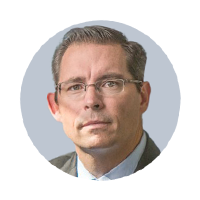 | Joseph H. Davis, Ph.D. Global Chief Economist and Global Head of the Investment Strategy Group, Vanguard |
Our research points to a higher neutral rate in the US over the coming decade, relative to the low-rate environment that pervaded pre-Covid-19, in part due to factors such as an aging population and rising structural deficits.
So, our outlook is that US interest rates above pre-pandemic levels are here to stay. In both our positive and negative AI scenarios, we expect the US federal funds rate to stay above 4%, but for different reasons. In the positive scenario, the 4% rate reflects higher economic growth. In this scenario, the yield curve may remain flatter than some think, creating opportunities for active risk-taking along duration. There may be similar dynamics around credit as well.
In the pessimistic scenario, it indicates growing structural deficits and financing pressures on the US government. There may also be greater inflationary pressure in this scenario. This would likely be a very different environment, one in which rates may be rising and the curve is getting steeper, possibly creating opportunities for active risk-taking.
Higher sustained interest rates would mean less return would come from price appreciation, and more return would come from reinvesting at higher rates. Generally, we’d be entering an era where bonds offer greater value in a portfolio than they did in the low-rate environment that followed the global financial crisis.
In terms of active management within a fixed income allocation, neither environment sounds as “easy” as it may have been during the previous few decades when there was a secular downtrend in interest rates that began in 1983. There will be many sources of volatility to navigate to either mitigate potentially adverse price effects of a rising yield environment or take advantage of price dislocations. Either way, the coming decade seems ripe for active risk-taking in the sense that there are likely to be sources of volatility to navigate or take advantage of.
It seems particularly important if AI disappoints. In this scenario, being underweight in equities and overweight in fixed income could be beneficial because in that environment, you’d expect to see lower growth, disappointing earnings growth, and higher interest rates. Within fixed income, investors may benefit from an overweight to corporate bonds (including high yield) relative to US Treasuries. That’s because Treasury prices could come under pressure if investors become concerned about the sustainability of the US government’s fiscal deficit.
Biography
Joseph H. Davis, Ph.D., is Vanguard’s global chief economist and global head of the Investment Strategy Group. He leads a global 75-person research organization that is responsible for Vanguard’s thought leadership agenda as well as the development and oversight of the firm’s investment methodologies and models. Joe chairs the firm’s Strategic Asset Allocation Committee, which governs multi-asset-class investment solutions, and he is a member of the Senior Investment Committee for Vanguard’s Fixed Income Group. He also holds roles on global advice and product committees.
Joe is a frequent keynote speaker, has published white papers in leading academic and practitioner journals, and currently serves on the editorial board of The Journal of Portfolio Management and the Journal of Fixed Income. Previously, Joe has been one of few non-academic researchers ever to be recognized as a Research Fellow by the National Bureau of Economic Research for his contributions to our understanding of U.S. business cycles. Joe earned his B.A. summa cum laude from Saint Joseph’s University, earned his M.A. and Ph.D. in economics at Duke University, and is a graduate of the Advanced Management Program at The Wharton School of the University of Pennsylvania.
Investment risk information
The value of investments, and the income from them, may fall or rise and investors may get back less than they invested.
Important information
This is directed at professional investors and should not be distributed to, or relied upon by retail investors.
The information contained herein is not to be regarded as an offer to buy or sell or the solicitation of any offer to buy or sell securities in any jurisdiction where such an offer or solicitation is against the law, or to anyone to whom it is unlawful to make such an offer or solicitation, or if the person making the offer or solicitation is not qualified to do so. The information does not constitute legal, tax, or investment advice. You must not, therefore, rely on it when making any investment decisions.
The information contained herein is for educational purposes only and is not a recommendation or solicitation to buy or sell investments.
Issued in Switzerland by Vanguard Investments Switzerland GmbH.
© 2025 Vanguard Investments Switzerland GmbH. All rights reserved.